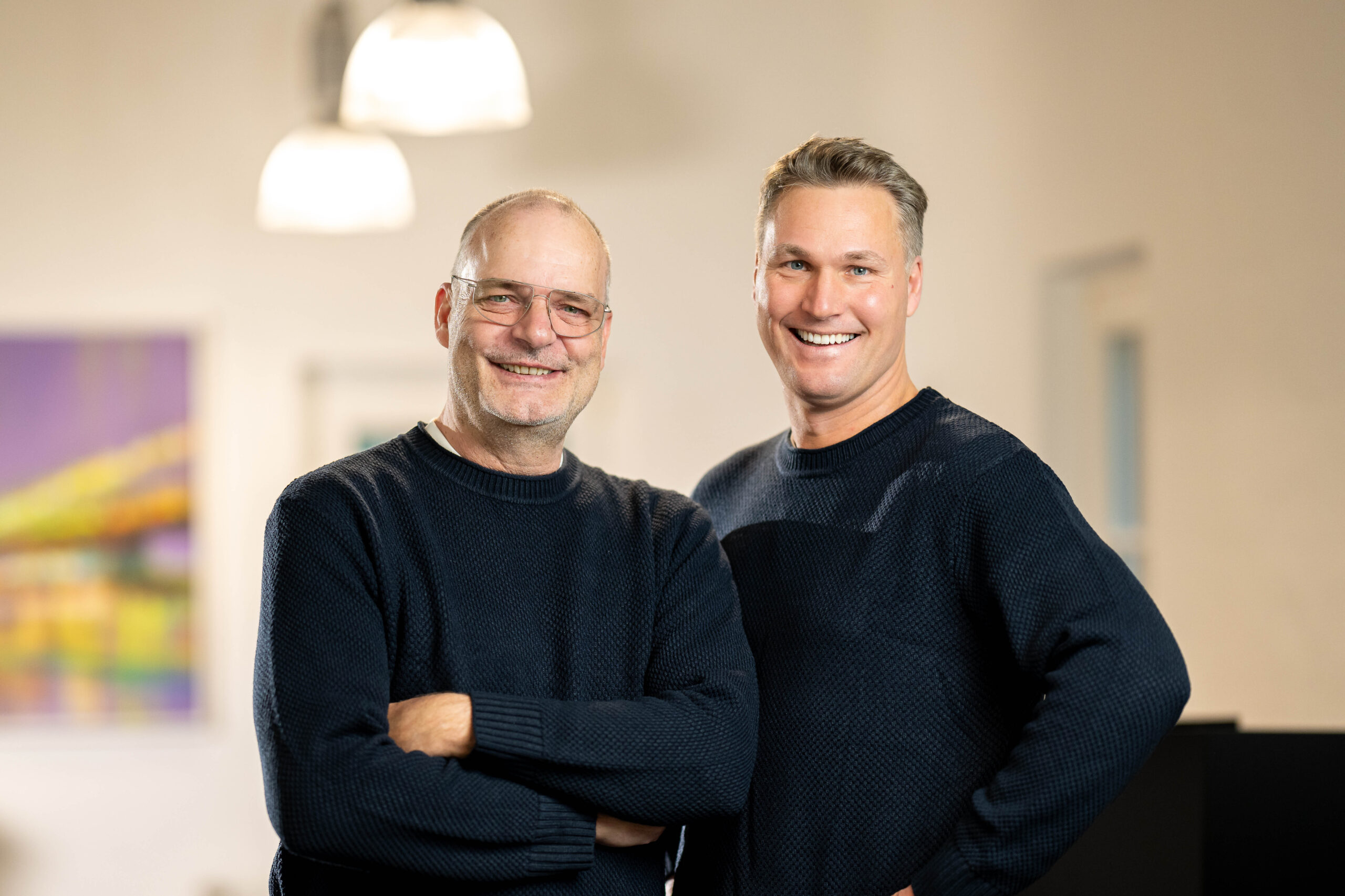


SORIWA GmbH, based in the Münsterland region of Germany, has developed the SORIWA Multi-System, a steel-free installation system for drywall construction. In this interview, founders Michael Sommer and Andreas Ridder talk about the idea behind the system, their research process, and their vision of a “green” drywall solution.
Mr Sommer, Mr Ridder, what was the starting point for your development?
Michael Sommer: The initial question was actually quite simple: Do we really need steel in drywall construction? Over the decades, metal profiles have become the industry standard. But anyone concerned with resource efficiency, carbon footprints, and circularity knows that steel is energy-intensive to produce, complex to recycle, and not always the optimal solution for interior construction.
Andreas Ridder: It was clear to us that drywall construction neede to be fundamentally rethought. We wanted to explore whether an alternative could be developed that is functionally equivalent - or even superior - while being made from a material that conserves resources and opens up new possibilities.
Why did you choose pulp fibres?
Andreas Ridder: Pulp fibers are the first thing that comes to mind when you want to work in a circular economy. They come from recycling streams, are readily available, and can be easily shaped. But it wasn’t as if we had the perfect solution right away. It all started with a long process of material testing, trial and error, and optimization.
Michael Sommer: The biggest challenge was that we couldn’t treat the fibers the same way we treat wood. Wood profiles already exist, but cellulose is a material all its own. So we had to develop a geometry that provides stability to the fibers; we had to design layered structures and use fasteners that result in a load-bearing component. It was only after many trials that we developed a profile that meets the requirements of drywall construction.
Can you give an example of these challenges?
Michael Sommer: Moisture was a classic challenge. Fibers are hygroscopic; they absorb water. So we had to ensure that the profile would retain its shape and load-bearing capacity even under construction site conditions. That meant intensive laboratory testing, adjustments during production, and ongoing feedback from research institutions.
Andreas Ridder: Another issue was standardization. Drywall profiles are clearly defined in Germany. If you suddenly introduce a completely different material, you have to prove that it meets—or exceeds—the same requirements. Fire safety, load-bearing capacity, workability: All of these aspects were tested before we could take the step toward obtaining general building authority approval.
How did a single profile evolve into a complete system?
Andreas Ridder: It actually started with the idea of developing a replacement for CW profiles. But we quickly realized that if we really wanted to create an alternative, we needed a complete system. After all, drywall construction is modular—profiles, connectors, reinforcements.
Michael Sommer: That’s how the Multi-System came about. We developed a connector that allows for the frame construction without using traditional UW profiles. And we designed the core, which is used in high-stress areas such as door openings. The result is a completely steel-free stud frame. This system concept was a decisive step.
What kind of feedback have you received in practice?
Michael Sommer: At first, of course, there was skepticism. Many tradespeople couldn’t imagine that fibers could replace steel. But as soon as they held the material in their hands, their perspective changed. The profiles are lighter, they can be worked with standard tools, and there are no sharp edges—that’s what makes the difference in practice.
Andreas Ridder: Another important point was that we didn’t invent a completely new construction method. Everything works the way tradespeople are used to. That makes it easy to get started. For us, innovation doesn’t mean throwing everything out, but rather improving what already exists.
You speak about the “green wall.” What does this vision entail?
Andreas Ridder: We’ve taken a big step forward with the Multi-System. But we’ve set our sights even higher. We want to create a wall in which not only the profiles but all components are recyclable—right down to the panels and insulation materials.
Michael Sommer: We call this the “green wall.” The goal is for an entire interior wall to consist, in the future, of materials that can be returned to the cycle. Our Multi Profil is the first building block toward that goal. What’s crucial for us is that these new materials must not be significantly more expensive than today’s standard products, and they must be able to be installed using the same tools and procedures. We want to develop systems that are ecologically sustainable without becoming a cost or labor burden for designers and tradespeople. Our vision is a construction method that is economical, practical, and at the same time circular—moving away from the linear “raw materials in, waste out” model toward a closed-loop material cycle.
Looking back, what was the most important moment in your development?
Michael Sommer: For me, it was the day we built the first complete room using our system. Suddenly, the idea had become a reality. We could see, feel, and measure that it worked, and at the same time experience just how effortlessly the material could be worked with. Particularly impressive was the reaction of the drywall installer, who was skeptical at first but then continued working with visible enthusiasm. He later told us that while working, he almost felt like the “MacGyver of drywall”—because simple tools suddenly opened up entirely new possibilities for him. At that moment, it became clear: Our concept not only works in the lab, but also delivers on the job site.
Andreas Ridder: For me, it was the moment the building code approval was granted. That made it clear: It’s not just a vision, but an approved building product that can be used in practice.
And what about the future?
Andreas Ridder: We’re just getting started. The multi-system is a foundation. But development continues—with new components, research partners, and pilot projects. We want to show that resource-efficient construction isn’t a compromise, but a step forward.
Michael Sommer: And we want to give tradespeople, planners, and architects a tool that will allow them to put this progress into practice right away. That is what drives us.